How to Start an LLC in Minnesota: Step-by-Step Guide (2026)
Disclosure: Some of the links in this article are affiliate links, meaning we may earn a commission if you click through and make a purchase, at no additional cost to you. We only recommend services we've researched and believe will be genuinely helpful.
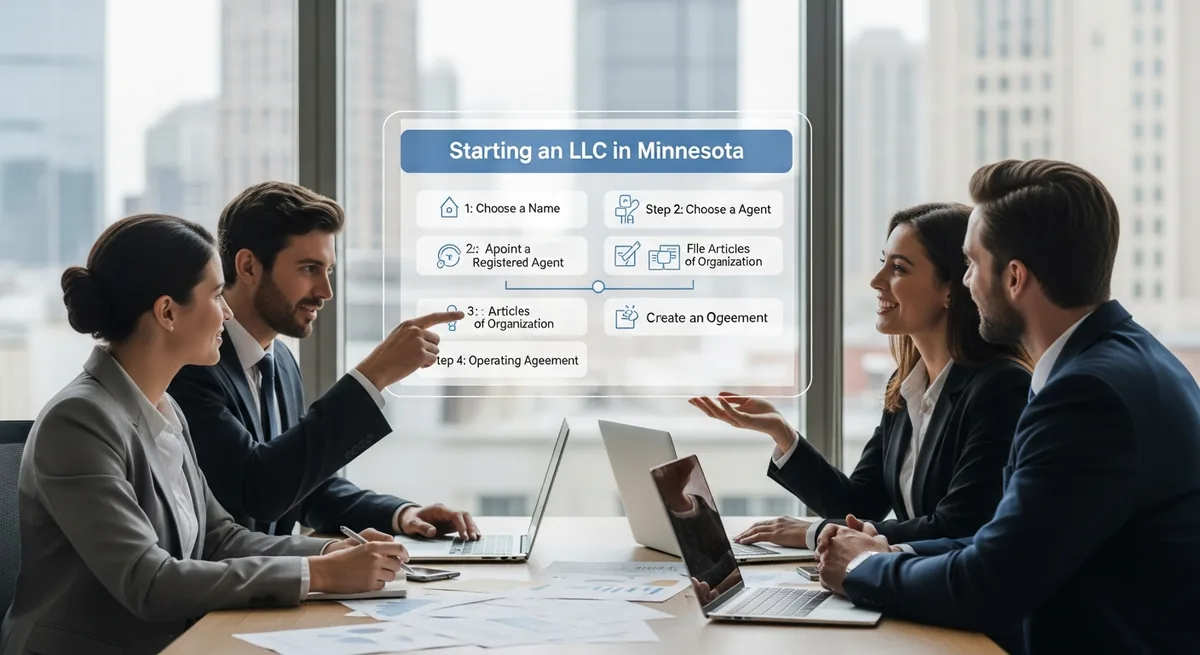
Minnesota is home to 17 Fortune 500 companies — UnitedHealth Group, Target, Best Buy, 3M, and General Mills among them — and that same business-friendly infrastructure trickles down to first-time founders. If you’re wondering how to start an LLC in Minnesota, the good news is that the state’s process is one of the more streamlined in the country: no publication requirement, no franchise tax, and a free annual renewal instead of the costly annual report fees you’d find in states like California.
Here’s the short version: you’ll pick a compliant name, appoint a Minnesota registered agent, file Articles of Organization with the Minnesota Secretary of State (the fee runs $135 by mail or $155 online as of 2026), draft an operating agreement, get your EIN, and handle a few tax registrations. You can do all of this yourself directly through the state, or use a formation service to handle the paperwork. Most of the founders I work with go with ZenBusiness, which forms your LLC for $0 plus the state filing fee and throws in a full year of free registered agent service — a combination that’s hard to beat for a first LLC.
In this guide, I’ll walk through every step of starting an LLC in Minnesota in 2026, including the exact costs, the paperwork you actually need (versus what’s just nice to have), the tax decisions that trip people up, and how the major formation services stack up if you’d rather not file it yourself.
Why Start an LLC in Minnesota?
Before the mechanics, it’s worth understanding why an LLC — and specifically a Minnesota LLC — makes sense for most small business owners.
An LLC (limited liability company) separates your personal assets from your business’s debts and liabilities. If your business gets sued or can’t pay a vendor, your house, car, and personal savings are generally protected — assuming you’ve kept business and personal finances separate. Compare that to a sole proprietorship, where there’s no legal distinction between you and the business at all. If you’re still weighing the two, our breakdown of LLC vs. sole proprietorship covers the tradeoffs in more depth, and our general primer on what an LLC actually is is a good starting point if you’re new to entity structures altogether.
Minnesota-specific advantages include:
- No franchise tax. Unlike California’s flat $800 annual franchise tax, Minnesota doesn’t charge LLCs a recurring privilege-of-doing-business fee.
- A free annual renewal. Most states charge $50–$300 every year just to keep your LLC in good standing. Minnesota’s annual renewal is free — you just have to remember to file it (more on that below, because this is where I’ve seen good businesses get administratively dissolved).
- A strong professional and economic base. The Twin Cities metro, Rochester’s health-tech corridor around Mayo Clinic, and a growing logistics and manufacturing sector give Minnesota LLCs real regional demand to tap into.
The tradeoff: Minnesota’s top individual income tax rate is 9.85%, one of the highest in the country, and that rate applies to pass-through LLC income by default. It’s not a reason to avoid forming here — you’d owe individual tax on business income wherever you live and operate — but it’s a real number to plan around with a CPA, not an afterthought.
Step 1: Choose a Name for Your Minnesota LLC
Your LLC’s name must:
- Be distinguishable from every other business entity on file with the Minnesota Secretary of State
- Include “Limited Liability Company,” “LLC,” or “L.L.C.” (or an accepted abbreviation)
- Avoid restricted words like “bank,” “attorney,” or “university” without additional licensing paperwork
Search the Minnesota Secretary of State’s business name database before you fall in love with a name — it’s free and takes about 30 seconds. If you’ve found a name you like but aren’t ready to file, Minnesota lets you reserve it for 12 months for a small filing fee (roughly $35), which is worth doing if you’re still lining up a registered agent or waiting on funding.
I’d also check that the name is available as a matching domain and on the socials you plan to use — that’s not a legal requirement, but nothing stalls a launch faster than picking a name at the Secretary of State only to find the .com is squatted on.
Step 2: Appoint a Minnesota Registered Agent
Every Minnesota LLC needs a registered agent — a person or company designated to receive legal notices (like service of process if you’re sued) and official state correspondence on the LLC’s behalf. Minnesota requires the agent to have a physical street address in the state (no P.O. boxes) and be available during normal business hours.
You have three options:
- Be your own registered agent. Free, but your name and home address become part of the public record, and you need to be reachable at that address during business hours — a real problem if you travel or work from a co-working space.
- Appoint a friend, business partner, or employee with a Minnesota address.
- Use a commercial registered agent service. Typically $100–$150/year, and it keeps your personal address off public filings.
If privacy is your main concern, Northwest Registered Agent is the strongest option in this category — they’ve built their entire reputation around not selling your data and using their own address on your public filings instead of yours. For most founders, though, we default to bundling this with formation: ZenBusiness includes a full year of registered agent service free with every plan, including its $0 starter tier, so there’s rarely a reason to buy it separately if you’re already using a formation service. For more on what this role actually covers, see our guide to what a registered agent is.
Step 3: File Articles of Organization with the Minnesota Secretary of State
This is the step that legally creates your LLC. You’ll file Articles of Organization with the Minnesota Secretary of State, either online through the state’s business portal or by mail.
You’ll need:
- Your LLC’s name
- Your registered agent’s name and Minnesota street address
- The organizer’s name and address (the person filing — this doesn’t have to be an owner)
- Optionally, a business address if different from the registered agent’s
Filing fee: $155 online, $135 by mail (fees are set by the Secretary of State and can change, so confirm the current amount before you file).
Processing time: Online filings are typically processed within a few business days; mailed filings can take four to six weeks. If you’re on a timeline — say, a bank wants to see your approved Articles before opening a business account — file online.
This is also the step where formation services earn their fee. Filing yourself costs only the state fee, but you’re responsible for getting every field right and tracking the status. A service like ZenBusiness or LegalZoom files this for you, checks it against the state’s requirements before submission, and gives you a dashboard to track approval — worth the cost if this is your first LLC or you’d rather not learn Minnesota’s filing quirks firsthand.
Step 4: Draft a Minnesota LLC Operating Agreement
Minnesota doesn’t legally require you to file — or even have — a written operating agreement. In my experience, that’s exactly why so many single-member LLC owners skip it, and exactly why it causes problems later. I’ve watched more than one Minnesota founder get stuck at the finish line trying to open a business bank account because the loan officer asked for an operating agreement and they had nothing to show. Banks, investors, and even the IRS (if you’re ever questioned about whether your LLC is being run as a legitimate business rather than a hobby) will ask for it.
At minimum, your operating agreement should cover:
- Ownership percentages and capital contributions
- How profits and losses are allocated and distributed
- Management structure (member-managed vs. manager-managed)
- What happens if a member wants to leave, dies, or wants to sell their stake
- Voting rights and how major decisions get made
Multi-member LLCs need this even more than single-member ones — without it, Minnesota’s default LLC statute governs your business, and those defaults rarely match what partners actually intended. Most formation services, including ZenBusiness and Tailor Brands, include an operating agreement template as part of their standard packages, and our LLC operating agreement guide walks through what a solid one should include if you’re drafting your own or reviewing one a service generated for you.
Step 5: Get Your EIN and Register for Minnesota Taxes
Your EIN (Employer Identification Number) is your business’s federal tax ID — you’ll need it to open a business bank account, hire employees, and file taxes. Getting one directly from the IRS is free and takes about 15 minutes online; our step-by-step EIN guide walks through the exact application. Be cautious here: some formation services and third-party sites charge $50–$100 to “get” your EIN for you. It’s not a scam exactly — you’re paying for convenience — but it’s never a cost you need to pay if you’re comfortable filling out the IRS form yourself.
By default, a single-member Minnesota LLC is taxed as a disregarded entity (income flows to your personal return via Schedule C) and a multi-member LLC is taxed as a partnership. Either way, Minnesota follows the federal characterization for state income tax purposes, and you’ll owe both the 15.3% federal self-employment tax and Minnesota’s individual income tax (up to 9.85%) on your share of the profit.
Once your net profit clears roughly $40,000–$60,000 a year, it’s worth talking to a CPA about electing S-corp tax treatment (via IRS Form 2553). This lets you pay yourself a reasonable salary and take the remaining profit as a distribution not subject to self-employment tax — a real savings, but one that comes with added payroll and accounting overhead, so the math only works past a certain profit threshold. This is a tax strategy decision, not a one-size-fits-all recommendation — run your specific numbers with a licensed CPA before electing.
If you’ll sell taxable goods or services, you’ll also need to register for a Minnesota Tax ID through the Department of Revenue’s e-Services portal to collect and remit sales tax.
Don’t forget federal beneficial ownership reporting. Under the Corporate Transparency Act, many LLCs were originally required to file a Beneficial Ownership Information (BOI) report with FinCEN. In March 2025, FinCEN narrowed this requirement significantly, largely exempting domestic companies formed in the U.S. and focusing the rule on foreign entities registered to do business here. Because this rule has shifted more than once, don’t rely on secondhand summaries (including this one) — confirm your LLC’s current filing obligation directly at FinCEN.gov and see our BOI report guide for the latest details, since exemptions and enforcement posture can change again with little notice.
Step 6: File Your Minnesota Annual Renewal
Here’s the step people forget, because it costs nothing and feels optional. It isn’t. Every Minnesota LLC must file an Annual Renewal with the Secretary of State by December 31 each year to stay in good standing. Unlike most states, there’s no fee — but miss the deadline and Minnesota will administratively dissolve your LLC, at which point you lose your liability protection and have to go through a reinstatement process to get it back.
I bring this up because it’s the single most common compliance mistake I see with Minnesota LLCs specifically — owners assume that because there’s no annual report fee, there’s no annual report obligation. Set a calendar reminder now for every November, or use a formation service’s compliance-alert feature (ZenBusiness’s dashboard flags this automatically) so it isn’t something you find out about the hard way.
How Much Does It Cost to Start an LLC in Minnesota?
Here’s the full cost picture for 2026, from state-mandated fees to optional extras:
| Item | Cost |
|---|---|
| Articles of Organization (state filing fee) | $135 (mail) / $155 (online) |
| Name reservation (optional, 12 months) | ~$35 |
| Registered agent service (optional; often free year one with a formation service) | $0–$150/year |
| Operating agreement (template vs. attorney-drafted) | Free–$99+ |
| EIN (direct from IRS) | Free |
| Annual renewal | Free |
| Business licenses/permits (varies by industry and city) | Varies |
| Optional S-corp election support (payroll/accounting) | $800–$2,000+/year |
The bare-minimum cost to start an LLC in Minnesota, filing everything yourself, is the $135–$155 state fee. Add a formation service to handle the paperwork and bundle a year of registered agent service, and you’re typically still looking at the state fee plus $0–$50 depending on which plan you choose. For a broader breakdown of what LLCs cost across all 50 states, see our guide on how much an LLC costs.
Best LLC Formation Services for Your Minnesota LLC in 2026
If you’d rather not handle the filing yourself, here’s how the major services compare for Minnesota formations specifically, in the order we’d recommend evaluating them:
| Service | Starting Price | Registered Agent Year 1 | Best For |
|---|---|---|---|
| ZenBusiness | $0 + state fee | Free | Best overall value and support |
| LegalZoom | $0 + state fee | Often a paid add-on | Brand recognition, add-on ecosystem |
| Tailor Brands | $0 + state fee | Included on higher tiers | Founders who also need branding/logo |
| Inc Authority | $0 + state fee | Free (basic) | Bare-bones budget formation |
| Northwest Registered Agent | ~$39 + state fee | Free | Privacy (keeps your address off filings) |
| Bizee | $0 + state fee | Free year one, then ~$119/year | Budget formation, simple LLCs |
| LLC Attorney | ~$399+ | Varies | Attorney review for complex/high-risk entities |
ZenBusiness is our top pick for Minnesota LLCs. Its $0 Starter plan (plus the state’s $135–$155 fee) still includes a free year of registered agent service and a compliance dashboard that flags your annual renewal deadline automatically — the exact thing that catches most Minnesota owners off guard. Paid tiers ($199–$299/year) add worry-free compliance monitoring, an operating agreement, and banking resolution documents. For a side-by-side, see our ZenBusiness review.
LegalZoom is the more recognizable brand and a fine second choice, particularly if you want access to its broader legal-services ecosystem (trademark filing, attorney consultations) down the road. The catch: unlike ZenBusiness, LegalZoom’s basic plan often lists registered agent service as a separate paid add-on rather than bundling a free first year — a meaningful cost difference if you’re price-sensitive on a first LLC. See our full LegalZoom review or our direct ZenBusiness vs. LegalZoom comparison for the detailed breakdown.
Tailor Brands is worth a look if you’re forming the LLC and building your brand identity (logo, business cards, basic website) at the same time — it bundles both in a way the pure-formation services don’t.
Inc Authority offers genuinely free base formation (you pay only the state fee) but leans harder on upsells once you’re in the funnel — read the fine print on what’s actually included before assuming “free” covers everything you need.
Northwest Registered Agent earns its reputation on privacy: it uses its own address instead of yours on your public Articles of Organization. If that’s your top priority, Northwest is the strongest pick on this list — though for most Minnesota founders, we still lead with ZenBusiness for the combination of price, support, and compliance tools.
Bizee (formerly Incfile) offers free base formation similar to Inc Authority, with registered agent service free for year one before renewing around $119/year — still cheaper long-term than LegalZoom’s model, but without ZenBusiness’s compliance-alert dashboard.
LLC Attorney is the right call if your situation is more complex than a standard single-member LLC — multiple owners with unequal ownership stakes, a real estate holding structure, or an industry with elevated liability exposure. You’re paying more for actual attorney involvement rather than a template-based workflow, and for some structures that’s money well spent.
FAQ: How to Start an LLC in Minnesota
How much does it cost to start an LLC in Minnesota? The state filing fee for Articles of Organization is $135 by mail or $155 online, as of 2026. Beyond that, costs depend on optional extras like a registered agent service, name reservation, or using a formation company — but the legal minimum to start an LLC in Minnesota is just the state filing fee.
How long does it take to form an LLC in Minnesota? Online filings with the Minnesota Secretary of State are typically processed within a few business days. Mailed paper filings can take four to six weeks. If speed matters, file online directly or through a formation service that submits electronically.
Do I need a registered agent for my Minnesota LLC? Yes. Minnesota law requires every LLC to designate a registered agent with a physical Minnesota street address to receive legal and state correspondence. You can serve as your own agent, but many owners use a commercial service to keep their home address off public records.
Do I need an operating agreement for a Minnesota LLC? Minnesota doesn’t legally require one, but banks, investors, and multi-member LLCs need it in practice. Without one, Minnesota’s default statutory rules govern your LLC, which rarely match what owners actually intended for profit-sharing or decision-making.
Does Minnesota require an annual report for LLCs? Minnesota requires an Annual Renewal, not a traditional annual report, due by December 31 each year — and unlike most states, it’s free to file. Missing the deadline can result in administrative dissolution of your LLC.
Do I need a business license to start an LLC in Minnesota? Minnesota doesn’t have a single general state business license requirement, but specific industries (contracting, cosmetology, food service, professional services) require licenses or permits at the state, county, or city level. Check with your local city or county clerk in addition to state requirements.
Can I be my own registered agent in Minnesota? Yes, as long as you have a physical Minnesota street address (not a P.O. box) and are available there during normal business hours to accept legal documents. The tradeoff is that your name and address become part of the public record.
Do I still need to file a BOI report for my Minnesota LLC in 2026? It depends. FinCEN significantly narrowed BOI reporting requirements in 2025, largely exempting domestic U.S. companies and focusing the rule on foreign entities registered to do business here. Because this rule has changed more than once, confirm your LLC’s current obligation directly at FinCEN.gov rather than relying on outdated guidance.
Final Thoughts
Starting an LLC in Minnesota in 2026 is genuinely one of the more affordable, lower-friction state formation processes in the country — no franchise tax, a free annual renewal, and a filing fee under $160. The paperwork itself takes an afternoon; the parts worth slowing down for are the ones with real consequences later — getting your operating agreement in writing, confirming your BOI filing status, and not missing that December 31 annual renewal.
If you’d rather have someone else handle the filing and keep track of your compliance deadlines, ZenBusiness remains our top recommendation for Minnesota founders, with LegalZoom as a solid alternative if you want access to a broader legal-services ecosystem. Whichever route you take, our best LLC formation services hub has the latest pricing and feature comparisons if you want to look beyond the two we’ve highlighted here.
The author name used in this article may be a pen name or pseudonym and is used for illustrative and editorial purposes only. This article is for informational purposes only and does not constitute investment, tax, or legal advice. Consult qualified professionals — including a licensed attorney and CPA — before making financial or legal decisions regarding your business formation, tax elections, or compliance obligations. State fees, tax rates, and regulatory requirements referenced here reflect information available as of 2026 and are subject to change; confirm current details with the Minnesota Secretary of State, the IRS, and FinCEN before relying on them.

James Caldwell
James Caldwell is a corporate compliance and tax strategist with over 15 years of experience helping small business owners navigate entity selection, tax planning, and regulatory requirements.