Delaware LLC Cost and Fees Breakdown (2026): What You'll Actually Pay
Disclosure: Some of the links in this article are affiliate links, meaning we may earn a commission if you click through and make a purchase, at no additional cost to you. We only recommend services we've researched and believe will be genuinely helpful.
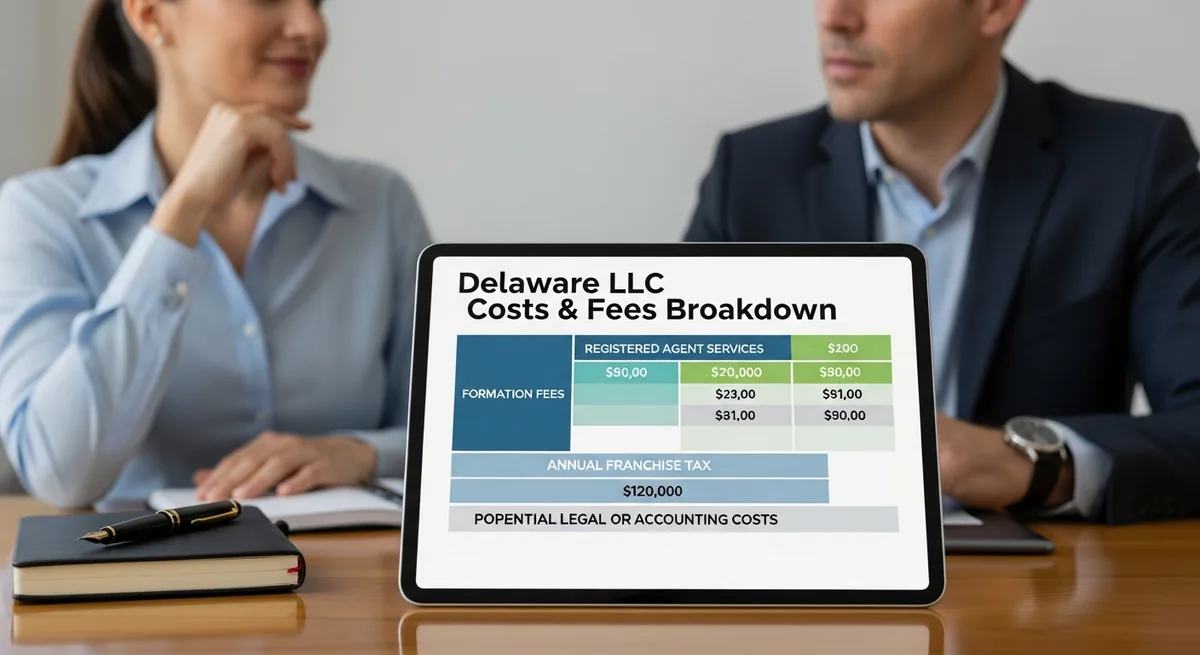
Delaware processes more than 300,000 new business entity formations each year, according to the Delaware Division of Corporations — more than any other state. It’s the default choice for venture-backed startups, holding company structures, and anyone who’s read that Delaware is “the best state for business.” But the often-cited $90 filing fee tells only a fraction of the story.
The complete Delaware LLC cost and fees breakdown includes a mandatory registered agent (typically $50–$300/year), a $300 annual franchise tax, and — if you operate your business outside Delaware — potentially a second round of registration fees in your home state. Understanding the full picture before you file prevents sticker shock and helps you decide whether Delaware actually makes sense for your situation.
If you want to start the process while you read, ZenBusiness handles Delaware formations starting at $0 plus state fees and includes registered agent service free for the first year — the most cost-efficient entry point among major services in 2026.
Delaware LLC Cost at a Glance
Before diving into each line item, here’s the full fee landscape:
| Fee | Amount | Frequency |
|---|---|---|
| Certificate of Formation (state filing fee) | $90 | One-time |
| Expedited processing (24-hour) | +$50 | Optional |
| Same-day processing | +$100 | Optional |
| 1-hour processing | +$500 | Optional |
| Delaware registered agent | $50–$300 | Annual |
| Annual LLC franchise tax | $300 | Annual |
| EIN (IRS) | Free | One-time |
| Formation service fee | $0–$349+ | One-time or annual |
| Operating agreement | $0–$300+ | One-time |
| Name reservation (optional) | $10 | One-time |
| Certified copy of formation documents | $50/copy | As needed |
| Certificate of Good Standing | $50 | As needed |
First-year minimum (DIY, no service): ~$440 First-year realistic (with formation service): ~$390–$750 Annual recurring (years 2+): ~$350–$600
The State Filing Fee: $90 for a Certificate of Formation
Delaware charges $90 to file a Certificate of Formation — the founding document that legally creates your LLC. You submit it to the Delaware Division of Corporations, either online through their ICIS portal or by mail. Standard processing typically takes 7–10 business days.
Compared to other states, $90 is reasonable. Florida charges $125, New York charges $200, and Massachusetts charges $500. But unlike some states, Delaware’s low filing fee is paired with a mandatory annual franchise tax and registered agent requirement that make the ongoing cost higher than it first appears.
If you need faster turnaround, Delaware offers expedited tiers: 24-hour processing costs an additional $50 (total $140), same-day service adds $100 (total $190), and 1-hour service adds $500 (total $590). Formation services typically pass these fees through directly, so confirm whether expedited processing is included in a plan or billed as an add-on before you select a service.
Delaware Registered Agent: A Mandatory $50–$300/Year
This is the cost most people underestimate — and it’s non-negotiable. Every Delaware LLC must maintain a registered agent with a physical street address in Delaware at all times. A PO box won’t satisfy the requirement, and your home address doesn’t qualify unless it’s actually in Delaware.
For the overwhelming majority of people forming Delaware LLCs — who live and operate elsewhere — this means hiring a professional registered agent service. Learn what a registered agent does and why it matters here.
In practical terms, your registered agent receives official state correspondence and legal notices (service of process) on behalf of your LLC and forwards them to you. Miss a lawsuit notice because your registered agent address is wrong or lapsed, and a court can enter a default judgment against your company.
Here’s how the major services price this requirement in 2026:
| Service | Annual RA Fee | Notes |
|---|---|---|
| ZenBusiness | Free year 1, $99/year after | Bundled with formation plans |
| LegalZoom | $249/year | Sold separately from formation |
| Tailor Brands | Included in paid plans | Varies by tier |
| Inc Authority | Free year 1, $99/year after | Included at formation |
| Northwest Registered Agent | $125/year | Included with $39 formation fee |
| Bizee | $119/year | Included in some plans |
| Budget-only providers | $49–$79/year | Minimal service, less support |
In my experience working with small business owners on entity structuring, the registered agent fee is where I consistently see the most sticker shock. A founder forms in Delaware expecting to pay $90, then discovers they’ll owe $100–$250 per year indefinitely just to maintain good standing — on top of whatever their home state requires. If you’re a solopreneur in Ohio running a consulting business, that’s $400–$550/year in Delaware overhead before you invoice a single client.
Unlike LegalZoom, which bills registered agent service separately at $249/year, ZenBusiness includes it free in the first year and charges $99/year on renewal — a $150/year difference that compounds meaningfully. If you’re comparing services side-by-side, see our ZenBusiness vs. LegalZoom breakdown for a full head-to-head on pricing and features.
Delaware Annual Franchise Tax: $300 Flat, Due June 1
Delaware LLCs owe a flat $300 annual franchise tax. There’s no calculation based on revenue, payroll, or number of members — every LLC, whether it earned $0 or $10 million, pays exactly $300.
Get full details on the Delaware LLC franchise tax, deadlines, and penalty structure here.
Key terms:
- Amount: $300 flat
- Due date: June 1 each year
- Late penalty: $200 flat penalty (assessed the day after the due date)
- Interest: 1.5% per month on the unpaid tax balance after June 1
- Payment: Online through the Delaware Division of Corporations portal
An important clarification for 2026: Delaware corporations face a much more complex franchise tax calculation — either the authorized shares method or the assumed par value capital method, and the bill can reach thousands of dollars for companies with large authorized share counts. Delaware LLCs use the simple $300 flat fee. If you’ve seen alarming franchise tax figures cited online, those typically apply to corporations, not LLCs.
The franchise tax applies even if your LLC had zero revenue, zero activity, or no employees. It’s a maintenance fee for the privilege of existing as a Delaware entity. Letting it go unpaid converts your LLC to “not in good standing” status, which can impair your ability to enter contracts, open bank accounts, or conduct transactions in Delaware — and adds the $200 late penalty immediately.
Hidden and One-Time Costs
Beyond the core three fees, several additional costs apply depending on your situation:
EIN (Employer Identification Number) Free. Apply directly through the IRS online portal and receive your EIN in minutes. Any service charging $50–$100 to “obtain your EIN” is marking up a free government service. Formation services that include EIN filing in their plans are submitting the same IRS form on your behalf — worth it for convenience, not for access.
Operating Agreement Delaware doesn’t legally require an operating agreement, but it’s essential for establishing ownership percentages, voting rights, and management authority. Without one, Delaware’s default LLC rules govern your company — which may not reflect your actual intentions. Options in 2026:
- DIY with a template: $0–$50
- Included in formation service: ZenBusiness Pro and Premium plans include an operating agreement template; LegalZoom includes one in paid tiers
- Attorney-drafted: $200–$1,000+
Review our LLC Operating Agreement guide before deciding what level of customization you need.
BOI Report (FinCEN) Free to file directly with FinCEN, but required for most LLCs under the Corporate Transparency Act. LLCs formed in 2026 have 30 days from formation to file. Third-party filing assistance typically runs $25–$150. Missing the deadline carries penalties up to $591 per day under current enforcement. See the BOI Report Guide for full requirements.
Certificate of Good Standing $50 from the Delaware Division of Corporations. Not required at formation, but commonly requested by banks when opening business accounts, by lenders during underwriting, and when registering in other states.
Name Reservation $10 to reserve your desired LLC name for 120 days before filing. Most people skip this and simply check availability, then file immediately.
Formation Service Fees: DIY vs. Using a Service
Filing the Certificate of Formation yourself directly with the state costs $90 and requires no technical skill. The Delaware ICIS portal is reasonably user-friendly. The tradeoff is that you handle document accuracy, registered agent setup, and EIN on your own.
Using a formation service adds a service fee but centralizes compliance, document storage, and registered agent in one place. For most first-time LLC owners, that coordination value — especially for registered agent management — exceeds the service cost.
Here’s how the major providers compare for a Delaware LLC formation in 2026:
| Service | Base Service Fee | Registered Agent | Approx. First-Year Total |
|---|---|---|---|
| ZenBusiness | $0 (Starter) | Free year 1, $99/year after | ~$390 |
| LegalZoom | $0 (Basic) | $249/year | ~$639 |
| Tailor Brands | $0 (Basic) | Included in paid plans | ~$390–$590 |
| Inc Authority | $0 | Free year 1 | ~$390 |
| Northwest Registered Agent | $39 | $125/year | ~$554 |
| Bizee | $0 (Starter) | $119/year | ~$509 |
| LLC Attorney | $249+ | Varies | ~$639+ |
Estimates include $90 Delaware filing fee + $300 franchise tax (year 1) + service fee + registered agent cost. Does not include optional add-ons.
For most Delaware LLC formations in 2026, ZenBusiness offers the strongest value at the entry level. The Starter plan carries no service fee, handles all document preparation and state filing, and includes registered agent free for the first year. Their Pro plan ($199/year) adds an operating agreement template, EIN assistance, and expedited processing — meaningful if you’re forming quickly for a contract or funding round.
LegalZoom remains a credible second choice, particularly if you anticipate needing access to their attorney network for ongoing legal questions. But at $249/year for registered agent vs. ZenBusiness’s $99/year renewal, you’ll pay $150 more annually for a service that’s functionally identical in most cases.
For privacy-focused formations, Northwest Registered Agent is worth considering — their $39 base fee includes registered agent, and they have a strong reputation for not reselling client data to data brokers. See our full Northwest Registered Agent Review for details.
Read our best LLC formation services comparison if you want to evaluate all options side-by-side before deciding.
The Hidden Cost Nobody Mentions: Foreign Qualification
This is the single most overlooked element of the Delaware LLC cost and fees breakdown, and it affects the majority of people who form there.
If you form a Delaware LLC but conduct business in another state — which means most people — you’ll almost certainly need to foreign qualify your LLC in that state. Foreign qualification registers your Delaware entity as authorized to transact business locally. The threshold for triggering this requirement varies by state but generally includes activities like: maintaining an office, regularly entering contracts, or employing people in that state.
Foreign qualification costs include:
- A state filing fee (typically $50–$750 depending on the state)
- A second registered agent fee in your home state
- That state’s annual report and franchise tax obligations
Example: Delaware LLC operating in Texas (2026)
| Cost | Amount |
|---|---|
| Delaware Certificate of Formation | $90 |
| Delaware registered agent (year 1) | $0 (ZenBusiness Starter) |
| Delaware annual franchise tax | $300 |
| Texas foreign LLC registration fee | $750 |
| Texas registered agent | $99/year |
| Year 1 total | $1,239 |
| Annual recurring (year 2+) | $499/year |
Example: Delaware LLC operating in California (2026)
| Cost | Amount |
|---|---|
| Delaware Certificate of Formation | $90 |
| Delaware registered agent (year 1) | $0 (ZenBusiness Starter) |
| Delaware annual franchise tax | $300 |
| California foreign LLC registration fee | $70 |
| California minimum LLC franchise tax | $800 |
| California registered agent | $99/year |
| Year 1 total | $1,359 |
| Annual recurring (year 2+) | $1,199/year |
These numbers make a strong case for forming in your home state if you’re a local or regional business. The legal advantages of Delaware are real — but they’re most valuable for companies raising institutional capital or navigating complex multi-member governance. For a sole proprietor or small business operating in one state, the Delaware overhead often exceeds any structural benefit.
Our guide on the best state to form an LLC walks through this comparison in full, including Wyoming and Nevada as lower-cost alternatives with strong asset protection statutes.
Is Delaware Worth the Cost? An Honest Assessment
Delaware makes financial sense when:
- You’re pursuing venture capital. Many VC funds in 2026 still maintain informal or explicit preferences for Delaware entities — it removes friction in term sheet negotiations and means your operating agreement uses familiar legal infrastructure.
- You have multiple investors, complex ownership structures, or institutional partners. Delaware’s Court of Chancery — the nation’s most specialized business court — has centuries of case law on operating agreement interpretation, member disputes, and fiduciary duty. That predictability has real value.
- You want a holding company structure. Delaware is widely used for IP holding entities, real estate portfolio LLCs, and parent companies that own operating subsidiaries. Learn more about holding company LLC structures here.
- Privacy matters to you. Delaware doesn’t require member names in the public Certificate of Formation. Your ownership can stay off the public record — a meaningful benefit for certain real estate investors, public-facing individuals, or businesses in sensitive industries.
Delaware typically doesn’t make sense when:
- You’re a small local business or sole proprietor. The dual-state overhead can easily reach $600–$1,200/year more than simply forming in your home state.
- You operate exclusively in one state and don’t need the Court of Chancery’s jurisprudence.
- Your home state offers comparable protections at lower annual cost — Wyoming and Nevada, for example, charge lower annual fees and have strong charging order protections.
I’ve seen too many small business owners default to Delaware because they encountered it in an article that described it as the “gold standard” — without realizing that designation applies specifically to VC-backed corporations, not to single-member LLCs running consulting practices in the Midwest. If you can’t articulate a specific legal or investor-relations reason to be in Delaware, form at home and save the money.
For a detailed walkthrough of the Delaware formation process if you’ve decided it’s the right fit, see our guide on how to start an LLC in Delaware.
Total Cost Scenarios: Real Budgets for 2026
Scenario 1: DIY Delaware LLC, operate in Delaware
| Item | Cost |
|---|---|
| Certificate of Formation (self-filed) | $90 |
| Registered agent (budget service) | $49/year |
| Annual franchise tax | $300 |
| EIN (IRS direct) | $0 |
| Year 1 total | $439 |
| Annual recurring | $349/year |
Scenario 2: Delaware LLC via ZenBusiness, operate in Delaware
| Item | Cost |
|---|---|
| ZenBusiness Starter service fee | $0 |
| Delaware state filing fee | $90 |
| Registered agent (year 1 free) | $0 |
| Annual franchise tax | $300 |
| EIN (included) | $0 |
| Year 1 total | $390 |
| Annual recurring (year 2+) | $399/year |
Scenario 3: Delaware LLC via ZenBusiness, operate in California
| Item | Cost |
|---|---|
| ZenBusiness formation + DE state fee | $90 |
| Delaware registered agent (year 1) | $0 |
| Delaware franchise tax | $300 |
| California foreign LLC registration | $70 |
| California minimum franchise tax | $800 |
| California registered agent | $99 |
| Year 1 total | $1,359 |
| Annual recurring (year 2+) | $1,199/year |
Scenario 3 is the version that surprises most people — and illustrates why the cost to form an LLC in Delaware is genuinely state-dependent. What looks like a $90 decision becomes a $1,300+ first-year commitment the moment you add California compliance.
For the full national cost picture across all 50 states, see our guide on how much does it cost to form an LLC.
Frequently Asked Questions
How much does it cost to form a Delaware LLC in 2026? The minimum out-of-pocket cost is $90 — the Delaware Certificate of Formation state filing fee. But most people also need a registered agent ($50–$300/year) and will owe the $300 annual franchise tax in their first year. Realistically, budget $390–$750 for year one, depending on whether you use a formation service and which plan you select.
Do Delaware LLCs pay annual fees? Yes. Delaware LLCs owe a $300 flat annual franchise tax due June 1 each year, plus an ongoing registered agent fee (typically $50–$300/year depending on provider). Unlike Delaware corporations, LLCs don’t file an annual report — just the franchise tax payment. Missing the June 1 deadline triggers a $200 flat penalty plus 1.5% monthly interest.
Can I be my own registered agent in Delaware? Only if you maintain a physical street address in Delaware and are available there during normal business hours. If you live or work outside Delaware — which applies to most people forming there — you must hire a professional registered agent service. There are no workarounds to this requirement.
Is Delaware’s LLC franchise tax based on revenue or profits? No. Delaware LLCs pay a flat $300 annual franchise tax regardless of revenue, profit, number of members, or business activity level. An LLC that earned $0 and an LLC that earned $5 million pay the same $300. (Note: Delaware corporations face a much more complex calculation — this flat rate is exclusive to LLCs.)
What’s the penalty for paying Delaware franchise tax late? A flat $200 penalty applies immediately after the June 1 deadline, plus 1.5% per month interest on the unpaid balance. The $200 penalty is assessed regardless of how short the late period is — even one day late triggers the full $200. This makes the total owed $500 if you’re even a few days past June 1.
Do I need to foreign qualify if I form in Delaware but operate in another state? Almost certainly yes, if you’re conducting meaningful business activity (maintaining an office, signing contracts, employing people) in your home state. Foreign qualification requires a separate state filing fee — ranging from $50 in some states to $750 in Texas — plus a second registered agent in that state. Operating without foreign qualification when it’s required can result in state fines and loss of access to that state’s courts.
What’s the cheapest way to form a Delaware LLC? Filing directly through the Delaware Division of Corporations at $90 is the cheapest filing-only route. For managed formation with registered agent and EIN included, ZenBusiness Starter at $0 service fee (plus $90 state fee and registered agent costs) is the lowest-cost service option from a major provider. Inc Authority also offers $0 formation service fees, though their upsell flow is more aggressive.
Does Delaware offer privacy benefits for LLC owners? Yes. Delaware’s Certificate of Formation doesn’t require member or manager names to be listed publicly — only the registered agent’s name and address appears in public records. This provides meaningful baseline privacy compared to states like Arizona or New York, which require member names in formation documents. For deeper anonymity (where your name doesn’t appear anywhere in the chain), a Wyoming holding company structure can add another layer. Read our full anonymous LLC guide for how that structure works.
The Bottom Line
The Delaware LLC cost and fees breakdown is more layered than most guides admit. The $90 Certificate of Formation fee is accurate — but it’s only the entry cost. Add a mandatory registered agent ($50–$300/year), the flat $300 annual franchise tax, and potentially dual-state registration costs if you operate outside Delaware, and your realistic first-year investment runs $390–$1,400+ depending on your state and service choices.
For most small businesses, the critical question isn’t the cost differential — it’s whether Delaware’s legal infrastructure is relevant to your specific situation. If you’re raising venture capital, building a holding company structure, or navigating multi-investor governance, Delaware’s Court of Chancery and flexible LLC statute provide genuine value. If you’re a local business or sole proprietor, your home state will cost less and require less ongoing maintenance.
If you’ve decided Delaware is right for you, ZenBusiness offers the most cost-efficient path to formation in 2026 — $0 service fee, registered agent included free for the first year, and a streamlined filing experience that gets most LLCs active within a few business days.
The author name used in this article may be a pen name or pseudonym and is used for illustrative and editorial purposes only. This article is for informational purposes only and does not constitute investment, tax, or legal advice. State fees, franchise tax rates, and service pricing are subject to change; verify current figures with the Delaware Division of Corporations and your chosen formation service before filing. Consult qualified legal, tax, and financial professionals before making entity formation or business structure decisions.

James Caldwell
James Caldwell is a corporate compliance and tax strategist with over 15 years of experience helping small business owners navigate entity selection, tax planning, and regulatory requirements.