Holding Company LLC Structure Explained: A 2026 Guide for Smart Business Owners
Disclosure: Some of the links in this article are affiliate links, meaning we may earn a commission if you click through and make a purchase, at no additional cost to you. We only recommend services we've researched and believe will be genuinely helpful.
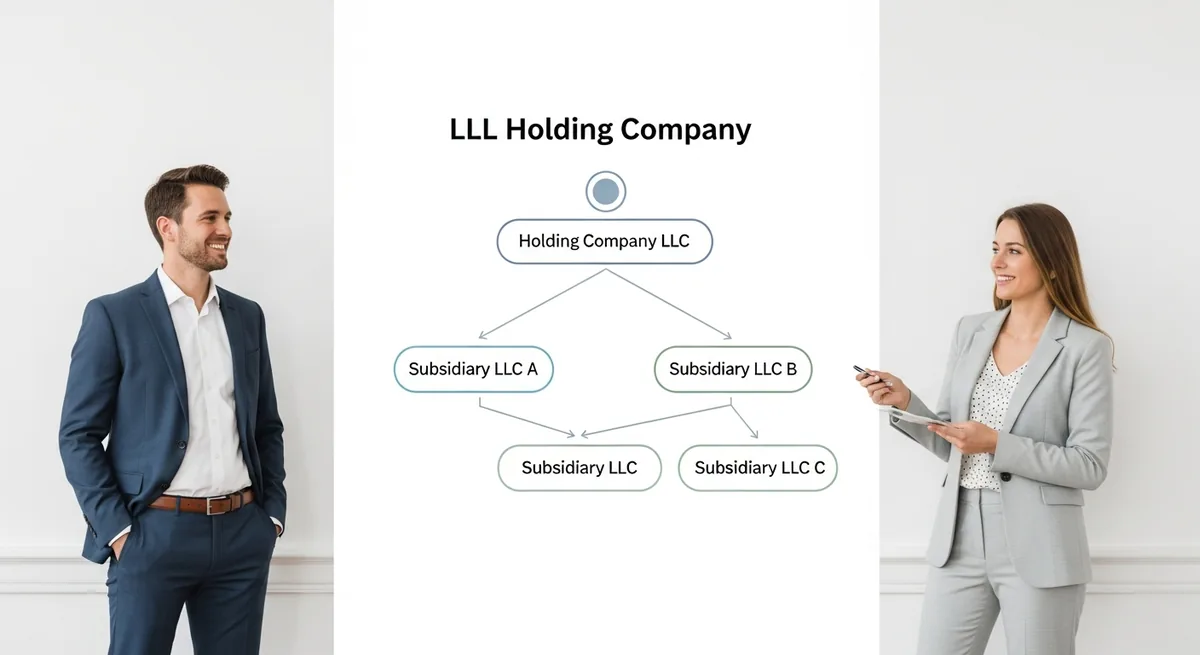
If you own more than one business — or you are about to — you have probably heard someone tell you to “put it under a holding company.” It is one of those phrases that gets thrown around at networking events and dropped casually by accountants, but the actual mechanics rarely get explained. So here is the holding company LLC structure explained in plain English, the way I wish someone had laid it out for me when I formed my first multi-entity stack in 2022.
In its simplest form, a holding company LLC is a parent limited liability company whose only real “business” is owning other companies — usually other LLCs. The subsidiaries do the actual operating work (running a restaurant, holding rental property, selling software), and the parent simply owns the membership interests of those subsidiaries. If you are forming the parent today and you want a low-friction setup, ZenBusiness currently runs $0 + state fees on its starter plan and includes the basics most holding companies need; in my experience it is the cleanest path for someone who does not want to fuss with paralegals just to get a parent entity on the books. We will get into the why in a moment, but I want you to have a picture of the structure before we dig in.
The reason this structure matters in 2026 is that it sits at the intersection of three very practical concerns: liability protection, tax efficiency, and clean transitions when you eventually sell or pass on a business. The IRS, state filing fees, and the post-Corporate Transparency Act reporting environment have all evolved in the past two years, and the playbook that worked in 2018 is not exactly the playbook that works now. Let’s walk through it carefully.
What a Holding Company LLC Actually Is
A holding company is not a special legal classification. There is no checkbox on a state filing form that says “this is a holding company.” Instead, a holding company LLC is just an ordinary LLC whose purpose, as stated in its operating agreement, is to hold ownership interests in other entities rather than to conduct business operations directly. The state of formation does not care whether you call it a holding company, a “ParentCo,” or “Smith Family Holdings, LLC” — what makes it a holding company is what it does (or rather, does not do).
A typical structure looks like this:
- Smith Holdings, LLC (the parent)
- Smith Coffee Roasters, LLC (operating subsidiary)
- Smith Real Estate Holdings, LLC (rental property subsidiary)
- Smith IP, LLC (owns trademarks and licenses them to the operating company)
Each subsidiary is a separate LLC with its own EIN, its own bank account, its own books, and its own liability shield. The parent owns 100% of the membership interests of each subsidiary. Sarah, the human, owns 100% of the parent. From the IRS’s perspective, if everything is a single-member LLC and nothing has elected corporate taxation, the entire stack is a “disregarded entity” pile and Sarah just files a Schedule C (or several Schedules E and C) on her personal 1040. The complexity is structural, not necessarily tax-filing-wise.
This is the holding company LLC structure explained in its most stripped-down form. Now let’s get into why anyone bothers.
Why People Use a Holding Company LLC Structure
There are five reasons I see again and again when business owners decide to set up a holding company LLC structure. Not all of them apply to everyone.
1. Asset Segregation and Liability Protection
This is the headline benefit. If a customer slips and falls in your coffee shop and sues, the lawsuit targets Smith Coffee Roasters, LLC. Your rental properties, sitting safely in Smith Real Estate Holdings, LLC, are not on the table. Without a holding company structure — say, if you ran the coffee shop and owned the rental properties under your personal name or under a single LLC — a judgment against the operating business could potentially reach the rental income or even the properties themselves.
This is why real estate investors with 4+ properties almost universally use this structure. The U.S. Small Business Administration has a helpful overview of choosing a business structure that touches on this principle. For a deeper look at the asset-protection logic specifically, our piece on whether an LLC can own property walks through the math for residential vs. commercial holdings.
2. Cleaner Sale or Succession
When you sell a business, the buyer typically wants to buy the operating LLC, not your entire empire. If Smith Coffee Roasters, LLC sits as a discrete subsidiary inside the holding company, you (the parent) sell the membership interests of that subsidiary and transfer it cleanly. If everything were jumbled into one LLC, you would either have to sell the whole thing or do an asset sale, which is messier and often less tax-efficient.
I have seen too many small-business owners learn this the hard way at the closing table when an offer comes in. Set the structure up before you need it.
3. Centralized Cash Management
The parent LLC can act as the treasury. Operating subsidiaries pay distributions up to the parent, and the parent redeploys cash to whichever subsidiary needs working capital. This is how Berkshire Hathaway works, just at a different scale. (Yes, the structure is the same; the zeros are different.)
4. Easier to Add Future Businesses
Once the parent exists, adding a new subsidiary is a 30-minute job. You form a new LLC, list the parent as the sole member, and you are off. No need to renegotiate operating agreements with partners every time you want to launch a side venture.
5. Privacy
If you form the parent in a privacy-friendly state (Wyoming, New Mexico, Delaware) and have it own subsidiaries in your operating states, the public record in the operating state typically shows the parent LLC as the member of the subsidiary — not your personal name. Combine this with a privacy-focused registered agent (this is one of the few cases where I actively recommend Northwest Registered Agent — they are #5 on our main list and best-in-class for privacy specifically), and your name can be reasonably hard to find through casual public-records searches.
How the Holding Company LLC Structure Actually Gets Built
Now to the practical part. Setting up a holding company LLC structure is not difficult, but the order of operations matters. Here is the sequence I follow.
Step 1: Form the Parent (Holding) LLC First
The parent has to exist before it can own anything, so this is always step one. Most people form the parent in either their home state, Delaware, or Wyoming. Wyoming is popular because of its low annual fees ($60 in 2026), strong charging-order protection, and privacy-friendly statutes. Delaware is popular because it is the default for businesses that anticipate raising outside capital. Home state is fine if you only have local operations.
For the parent, ZenBusiness at $0 + state fees is what I usually point people to — you do not need the bells and whistles for an entity that is not going to do anything operational. If you anticipate the holding company itself someday raising money or being structured to hold equity for outside investors, LegalZoom ($0 + state fees on the basic plan, with optional attorney consultations on higher tiers) is a reasonable upgrade.
For a year-by-year breakdown of what each state actually charges, take a look at our guide on the best state to form an LLC. The right answer depends on where you actually live and operate.
Step 2: Get the Parent an EIN and a Bank Account
Even though a single-member parent LLC is technically a disregarded entity for federal tax purposes, you still want an EIN (free from the IRS at irs.gov) and a separate bank account. Without those, you risk the dreaded “alter ego” problem where a court decides your LLCs are not actually separate from each other or from you, and pierces the veil. The whole point of the structure evaporates.
Step 3: Form Each Operating Subsidiary in the State Where It Operates
If your coffee shop is in Texas and your rental properties are in Florida, form Smith Coffee Roasters, LLC in Texas and Smith Real Estate Holdings, LLC in Florida. Do not try to run a Texas coffee shop through a Wyoming LLC — you will end up needing to register the Wyoming LLC as a foreign LLC in Texas anyway, and you will pay both states’ fees. It is the worst of both worlds.
When you file the certificate of formation for each subsidiary, list the parent LLC as the sole member. This is the part most DIY filers get wrong. They list themselves personally as the member, which collapses the entire structure. The whole reason you formed the parent is so the parent — not you — owns the subsidiary.
For step-by-step state filings I have already documented, see how to start an LLC in Texas or how to start an LLC in Florida. The mechanics generalize to most states.
Step 4: Each Subsidiary Gets Its Own EIN and Bank Account
Same reasoning as Step 2. Each subsidiary needs to function like a standalone entity on paper. Mixing funds between subsidiaries is one of the fastest ways to lose the liability shield.
Step 5: Operating Agreements Everywhere
Both the parent and every subsidiary need an operating agreement. The parent’s agreement should explicitly state that its purpose is to hold membership interests in subsidiaries. Each subsidiary’s agreement should name the parent as the sole member and specify how distributions flow up to the parent. If you skip these documents, a court can treat all your entities as one big alter ego — game over.
For a deeper look at this exact question of one LLC owning another, our piece on whether an LLC can own another LLC goes into the legal mechanics in more detail.
Tax Treatment: What the IRS Sees
This is where most articles either oversimplify or get it dead wrong, so I want to be careful. Here is how it actually works in 2026.
Default Treatment: Disregarded Entities Up the Stack
If every entity in your stack is a single-member LLC and none has filed Form 8832 to elect corporate taxation, the entire structure is “disregarded” for federal income tax purposes. Income, expenses, and depreciation flow up to your personal 1040. You file a single Schedule C for any operating subsidiary and Schedule E for rental real estate subsidiaries.
The IRS’s own guidance on single-member LLCs is the authoritative reference here.
Elective Treatment: Parent Taxed as an S-Corp
A common move once an operating subsidiary throws off enough profit (typically $80K+ of net earnings) is to have the parent (or sometimes a specific subsidiary) elect S-corp taxation by filing Form 2553. This lets you pay yourself a “reasonable salary” and take additional profit as distributions, which are not subject to self-employment tax. The savings can be meaningful — a 15.3% self-employment tax on, say, $50,000 of distributions is about $7,650 a year, less the cost of running payroll.
This is a whole topic of its own. If you are thinking about it, our LLC vs. S-Corp guide walks through the numbers.
Multi-Member Parents: Partnership Returns
If the parent has more than one member (say, you and a business partner), it has to file a partnership return (Form 1065) and issue K-1s, and the disregarded simplicity is gone. This is fine, but it adds complexity and usually a CPA bill of $1,500–$3,500 a year just for the parent’s return.
State-Level Taxes Are a Different Animal
Some states impose franchise taxes, gross-receipts taxes, or annual fees on every LLC, regardless of whether it has revenue. California, in particular, charges an $800 minimum annual franchise tax on every LLC — meaning a stack of 5 LLCs in California costs $4,000 a year just to keep the lights on. Texas has a franchise tax that hits LLCs with revenue above the threshold ($2.47M in 2026). Always price out the multi-entity overhead before you build a tower.
Costs: What You Will Actually Pay in 2026
Let me give you a realistic budget for a 3-entity structure (1 parent + 2 subsidiaries) in 2026.
| Cost Item | Range |
|---|---|
| State filing fees (3 entities) | $150–$1,200 (varies wildly by state) |
| Formation service fees | $0–$300 if you DIY through ZenBusiness or LegalZoom |
| Registered agent (3 entities) | $0–$450/year |
| Operating agreement templates | $0–$300 |
| EIN applications | Free (do not pay anyone for these) |
| Annual report fees (3 entities) | $0–$450/year |
| Franchise/minimum taxes | $0–$2,400/year |
| BOI reporting (3 entities) | Free if DIY |
| Year 1 Total | $150 to $5,100 |
| Year 2+ recurring | $0 to $3,300/year |
The wide range is mostly state choice. A 3-entity stack in Wyoming with DIY formation is roughly $400 in year one. The same stack in California is north of $3,000 in year one and $2,500+ every year after. Choose your state of formation deliberately.
For a fuller breakdown of what an LLC actually costs once you account for everything, see how much does it cost to form an LLC.
Comparison: Holding Company LLC vs. Series LLC vs. Multiple Independent LLCs
People often ask me to compare these three approaches.
| Structure | Setup Cost | Asset Protection | Complexity | When It Wins |
|---|---|---|---|---|
| Holding company LLC (parent + subs) | Medium — multiple filings | Strong, well-tested | Medium | Most multi-business owners and serious real estate investors |
| Series LLC | Low — one filing, internal series | Strong on paper, less tested in court across states | Medium-High (each series needs its own books) | High-volume real estate (5+ properties) in series-friendly states |
| Multiple independent LLCs (no parent) | Medium | Strong per-LLC, but no centralized treasury | Low | Just 2 truly unrelated businesses with no plan to add more |
A series LLC is essentially a single LLC that contains multiple internal “series,” each with its own assets and liabilities. It is cheaper to form than a holding company structure (one filing, not five) but a series LLC’s protection across state lines is still legally untested in some states, including non-series states like California. For most owners I work with, I prefer the holding company structure because it relies on well-established LLC law in every state, not on the relatively new and uneven series statutes.
Your accountant or business attorney can tell you which fits best for your facts. There is no universal right answer here.
A Real-World Example
Let me make this concrete. A reader who emailed me last fall — call her Maya — runs a Pilates studio that grosses about $400K, owns two rental duplexes worth roughly $850K combined, and freelances on the side as a brand consultant. She had everything under her personal name. We sketched out the following structure:
- Maya Wellness Holdings, LLC (Wyoming, the parent)
- Pilates by Maya, LLC (California operating sub, where the studio is)
- Maya Real Estate, LLC (Arizona operating sub, where the duplexes are)
- Maya Consulting, LLC (Wyoming sub for the consulting work, since she has clients in multiple states)
Total cost in year one: about $1,800 in state fees and formation costs. Annual recurring: about $1,400, dominated by California’s $800 minimum franchise tax on the Pilates sub. The benefit: a tenant slip-and-fall in Arizona cannot reach the Pilates studio’s revenue, and a disgruntled consulting client cannot reach the rental properties. When she eventually wants to sell the studio, the buyer purchases the membership interests of Pilates by Maya, LLC and Maya keeps everything else cleanly.
She used ZenBusiness to form all four entities for about $0 + state fees per entity, plus their registered-agent service. Total formation services cost: under $700. Took about three weeks to get everything filed.
The Beneficial Ownership (BOI) Wrinkle
I cannot leave this article without a quick word about the Corporate Transparency Act and Beneficial Ownership Information (BOI) reporting. As of 2026, every LLC in your stack — parent and subsidiaries — generally needs to file a BOI report with FinCEN, listing the human “beneficial owners” (anyone who owns 25%+ or exercises substantial control). The parent does not shield you from BOI reporting: at the end of the day, FinCEN wants to know about the humans behind the structure.
There are exemptions for large operating companies, but a typical small-business holding stack will not qualify for them. Plan to file a BOI report for each entity. Our step-by-step BOI filing guide walks through the mechanics. The good news: the filing itself is free and takes about 15 minutes per entity.
Common Mistakes I See
After reviewing dozens of holding company structures, these are the errors that come up the most:
- Listing yourself, not the parent, as the member of the subsidiary. Collapses the structure entirely. Refile if you did this.
- Single bank account across multiple LLCs. Same as above. The veil is gone the moment you commingle.
- No operating agreements. Especially the parent’s. Courts read this as evidence the structure was a sham.
- Forming subsidiaries in Wyoming when they operate in other states. You will pay both states’ fees and gain nothing.
- Skipping the registered agent fee to save $50. If you miss a service of process notice and a default judgment lands, you will wish you had paid the $50.
- Ignoring state franchise taxes when modeling the structure. A 5-entity stack in California costs $4,000/year just to exist. Know what you are signing up for.
Frequently Asked Questions
How much does it cost to set up a holding company LLC structure?
For a parent + two operating subsidiaries in a reasonable state, expect $400–$1,800 in year one and $300–$1,500 per year in ongoing costs. California adds $800 per LLC per year in minimum franchise tax, so multi-entity stacks there get expensive fast.
Do I need a separate EIN for each LLC in the structure?
Yes. Each LLC — parent and subsidiaries — needs its own EIN, even if every entity is a single-member disregarded entity for federal tax purposes. Banks require an EIN to open a business account, and operating without separate EINs and accounts undermines the liability shield.
Can a holding company LLC own an S-corp?
This is one of the biggest gotchas. An S-corporation cannot have an LLC as a shareholder unless that LLC is a single-member disregarded entity. So a single-member parent LLC can own an S-corp subsidiary, but a multi-member parent generally cannot. If you have a partner in the parent, your subsidiary’s S-election is at risk. Talk to a CPA before structuring.
What is the difference between a holding company LLC and a series LLC?
A holding company LLC is a parent LLC that owns separate subsidiary LLCs — each subsidiary is its own legal entity. A series LLC is a single LLC that contains internal “series,” each with separate assets and liabilities. Series LLCs are cheaper to form but their protections are less tested across state lines. For most owners, the holding company structure is more bulletproof.
Do I have to form my holding company in Delaware or Wyoming?
No. You can form the parent in any state — including your home state. Delaware and Wyoming are popular because of strong LLC law and low/no income tax, but if you do not have specific reasons to go out-of-state, your home state often makes more sense and avoids foreign-qualification fees in the state where you actually operate.
Will a holding company structure protect me from personal liability?
It protects you the same way any properly run LLC does — and only if you actually run it like a separate entity. Separate bank accounts, separate books, signed operating agreements, and no commingling of funds are required. If you do those things, the structure works. If you do not, courts can pierce the veil regardless of how many parents and subs you have on paper.
Do I need a lawyer to set up a holding company LLC structure?
For a simple structure (1 parent, 1–3 subsidiaries, single owner), a competent formation service like ZenBusiness plus a CPA review of the tax election is usually enough. If you have business partners, outside investors, complex IP, or anticipated litigation, hire a business attorney — the $2,000–$5,000 spend will pay for itself many times over.
How does a holding company LLC affect my taxes?
By default, a stack of single-member LLCs is taxed exactly like a single sole proprietorship — everything flows up to your personal 1040. The holding structure does not change your tax bill on its own. What it does do is give you the ability to make different tax elections at different levels (e.g., S-corp election for one subsidiary), and to clean up tax reporting when you sell or transfer one of the businesses. Always talk to a qualified tax professional before electing S-corp or partnership status.
Putting It All Together
The holding company LLC structure explained in one sentence: a parent LLC owns subsidiary LLCs, each of which runs a discrete business or holds discrete assets, so that liability, cash flow, and eventual sale or succession can be managed cleanly. It is not magic, it is not a tax shelter, and it does not work if you do not maintain it properly. But for an owner with two or more real businesses, it is the difference between a sturdy structure that serves you for decades and a single LLC that becomes a liability time bomb the day you scale.
If you are ready to set up the parent today, ZenBusiness is the path of least resistance for the parent and most subsidiaries — it is the service I default to in 2026 because the $0-plus-state-fees pricing on the starter plan is genuinely $0 (no last-minute upsells gating the basics). LegalZoom is a fine alternative if you want optional access to attorney consultations baked into a higher plan. For the privacy-conscious — say, a high-net-worth real estate owner — running the parent through Northwest Registered Agent for its registered-agent privacy practices makes sense. Compare the full lineup on our best LLC formation services list.
Build the parent first. Get its EIN and bank account. Then form each subsidiary with the parent listed as the sole member. Operating agreements everywhere. File your BOI reports. Keep clean books. Do those things and the structure does its job.
Disclaimer: The author name used in this article may be a pen name or pseudonym and is used for illustrative and editorial purposes only. This article is for informational purposes only and does not constitute investment, tax, or legal advice. Tax laws, state filing requirements, and BOI reporting obligations change frequently — figures and rules cited above reflect publicly available information as of 2026 and may not apply to your specific situation. Consult qualified professionals — a licensed business attorney and a CPA in your state — before making financial decisions or implementing the structures discussed.

Sarah Mitchell
Sarah has researched and tested over 20 LLC formation services since 2021. She has personally formed LLCs in 5 states.