LLC for Pool Cleaning and Pool Service Business: Setup, Insurance & Taxes (2026 Guide)
Disclosure: Some of the links in this article are affiliate links, meaning we may earn a commission if you click through and make a purchase, at no additional cost to you. We only recommend services we've researched and believe will be genuinely helpful.
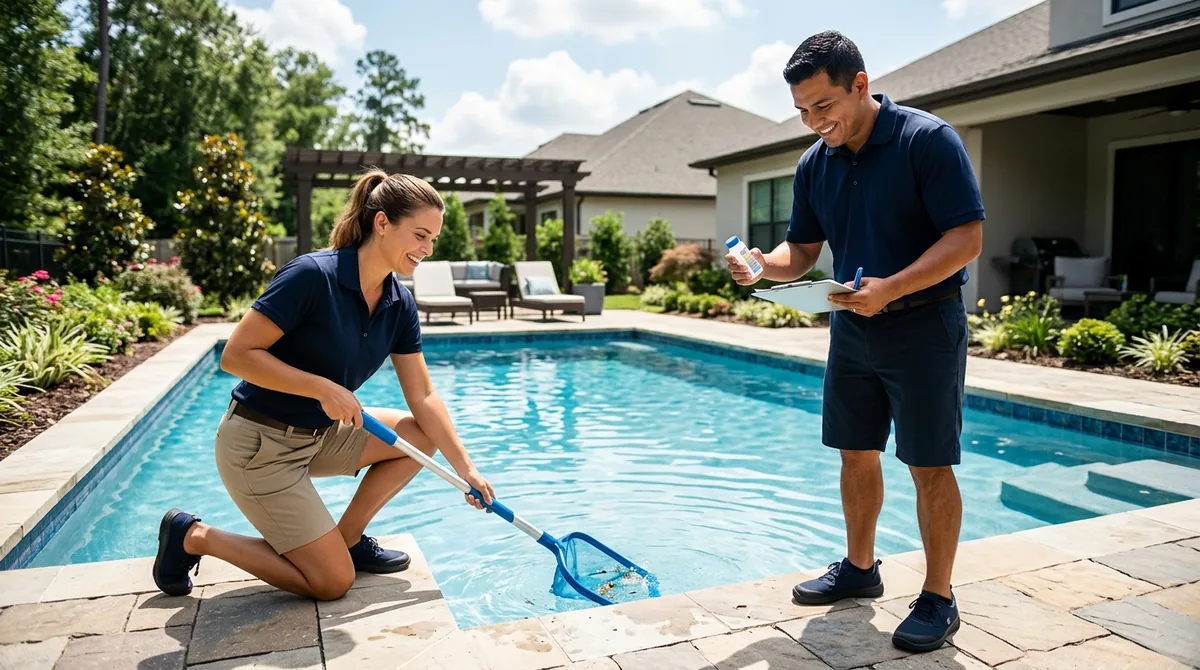
Pool service looks like a low-risk trade. You show up, skim leaves, balance the chemistry, and move to the next backyard. But you handle chemicals, work around electrical equipment, and operate on other people’s property every day. A single slip can turn into a five-figure claim. That is why forming an LLC for a pool cleaning and pool service business is one of the first moves I recommend to new route owners in 2026.
The good news is that setup is cheap and fast. A formation service such as ZenBusiness can file your LLC for $0 plus your state’s filing fee on its entry-level plan. Most states charge between roughly $50 and $500, and many filings clear in a few business days. This guide covers what an LLC does and doesn’t protect, how to set one up, what insurance you still need, and how taxes work.
Why a Pool Service Business Needs an LLC
Think about what can go wrong on a typical route:
- Chemical incidents. A technician mixes incompatible chlorine products, or leaves a bucket of acid within reach of a child. Chemical burns and respiratory injuries are real claims.
- Equipment damage. An overdosed pool stains plaster, a misconfigured valve burns out a $2,500 variable-speed pump, or a heater is damaged after a flow error.
- Slip-and-fall and property damage. Hoses across a patio, a gate left unlatched, or a dropped pole through a window.
- Employee injuries and vehicle accidents. Once you hire a helper or add a second truck, your exposure grows quickly.
Without an entity, you are a sole proprietor. If a judgment exceeds your insurance limits, the plaintiff can reach your personal savings, your car, and potentially your home. An LLC creates a legal wall between business liabilities and personal assets. For a deeper primer, see our guide on what an LLC is and the LLC vs sole proprietorship breakdown.
Here is my honest opinion, drawn from years of watching small service businesses: I’ve seen too many solo operators run a profitable 60-pool route for years with nothing but a handshake and a personal checking account, then lose everything over one avoidable accident. The LLC costs less than a single month of pool-chemical spend. Skipping it is a bad trade.
What an LLC Does (and Doesn’t) Protect
An LLC is a shield, not a force field. Understand the limits before you rely on it.
What it protects:
- Your personal assets from business debts and most lawsuits tied to the business
- You from contractual liabilities, such as a supplier account or vehicle lease signed in the company name
What it does not protect:
- Your own negligence. If you personally cause an injury, you can generally still be named in the suit. The LLC mostly protects you from liability caused by employees, partners, or the business’s debts.
- Personal guarantees. If you personally guarantee a truck loan, that debt follows you.
- Commingled finances. Courts can “pierce the veil” if you treat the LLC as your personal wallet.
This is why insurance and good record-keeping are essential partners to the entity. The IRS guidance on LLCs explains how these entities are classified for federal tax purposes.
Step-by-Step: Setting Up Your Pool Service LLC
1. Pick your state and business name
For nearly all route owners, form the LLC in the state where you actually work. Forming elsewhere (Delaware or Wyoming, for example) usually adds a second set of fees, because you must register as a foreign LLC where you operate. If you serve customers in Florida, Arizona, Texas, or California, form there. See our state guides for Florida, Texas, and California. If you cross state lines, read about foreign LLC registration.
Pick a name that is available in your state’s database and includes “LLC.” Names like “Crystal Blue Pool Care LLC” are easy to check and brand.
2. Appoint a registered agent
Every LLC needs a registered agent with a physical address in the state to receive legal papers. You can serve as your own, but you work in the field all day and may miss a service of process. A missed lawsuit notice can lead to a default judgment. Read what a registered agent is before deciding. Many formation packages include a first year of registered agent service.
3. File your Articles of Organization
This is the document that creates the LLC. File with your state’s Secretary of State, either directly or through a formation service. Fees vary widely. Our LLC cost breakdown shows how state fees compare, and the numbers can differ sharply (a few examples: Texas at $300, Florida at $125, California at $70 plus the annual $800 franchise tax, covered in our California franchise tax guide).
4. Write an operating agreement
Even a single-member LLC should have one. It documents ownership and how the business is run, and it supports your liability protection. Our operating agreement guide walks through what to include.
5. Get an EIN
You need an Employer Identification Number to open a business bank account, hire help, and set up payroll. It is free directly from the IRS. Our free EIN walkthrough explains how.
6. Open a dedicated business bank account
Run every dollar of route revenue and every chemical purchase through this account. This is the single best habit for keeping your liability shield intact. See our LLC bank account guide.
Licensing, Certifications, and Insurance
The LLC is only one layer. Pool service is regulated unevenly across states.
Licensing. Some states require a contractor or specialty license for pool service, particularly if you perform repairs or equipment replacement. Florida, for instance, has separate licensing categories for pool and spa servicing. Other states have no state-level license for basic cleaning but require local business licenses. Check with your state licensing board and city or county before your first stop.
Certifications. Many operators hold a Certified Pool/Spa Operator (CPO) credential through the Pool & Hot Tub Alliance. It is not legally required everywhere, but it signals competence to customers and insurers, and some commercial accounts require it.
Insurance. Expect to carry several policies:
| Coverage | What it covers | Typical need |
|---|---|---|
| General liability | Injury and property damage at customer sites | Essential from day one |
| Commercial auto | Your service truck | Required when the vehicle is used for business |
| Workers’ compensation | Employee injuries | Required in most states once you hire |
| Inland marine / tools | Equipment, test kits, and pumps in your truck | Strongly advised |
| Pollution / chemical liability | Certain chemical release claims | Check your general liability exclusions |
Premiums vary by state, route size, and claims history. Many small operators report annual general liability costs ranging from several hundred to a couple thousand dollars, but get written quotes. Read your policy’s exclusions carefully: many general liability policies exclude pollution or chemical events unless endorsed. Ask your agent specifically about chemical handling.
Commercial accounts (HOAs, apartment complexes, hotels) typically demand a certificate of insurance naming them as additionally insured. Having an LLC and a proper policy is often the price of admission for those higher-value contracts.
Choosing a Formation Service for Your Pool Business
You can file directly with your state for just the filing fee. But a formation service handles the paperwork and often bundles compliance reminders, which matters when your day starts at 6 a.m. in a truck. Here is how the main options compare, in our standard order:
| Service | Best for | Starting price (plus state fee) | Notes |
|---|---|---|---|
| ZenBusiness | Most route owners | $0 on the Starter plan | Paid tiers add registered agent, operating agreement, and compliance features |
| LegalZoom | Brand recognition, add-on services | $0 Basic, higher tiers add features | Costs rise with upgrades |
| Tailor Brands | Branding and logo bundled in | Varies by package | Useful if you need a logo and website |
| Inc Authority | Budget filing | $0 base filing | Some extras cost more |
| Northwest Registered Agent | Privacy | Higher flat fee | Strong privacy focus |
| Bizee | Free basic filing | $0 base filing | Upsells at checkout |
| LLC Attorney | Attorney-backed filing | Varies | Legal support for complex situations |
Pricing and plan features change often, so confirm current details on each provider’s site before buying.
My recommendation: For most pool service owners, ZenBusiness is the practical starting point. The entry-level plan keeps upfront costs low, and the mid-tier plans bundle a registered agent and an operating agreement, which are two things a busy route owner shouldn’t be chasing separately. Read the full ZenBusiness review for plan-by-plan detail. LegalZoom is a solid secondary option if you want a well-known brand and don’t mind paying more for add-ons; see our ZenBusiness vs LegalZoom comparison for the details. If you are weighing several providers, our best LLC services hub ranks them all.
One gotcha: the cheap or free filing tiers rarely include everything. Watch for upsells on registered agent service, rush processing, and operating agreements, and add them up before you compare headline prices.
Taxes for a Pool Service LLC in 2026
By default, a single-member LLC is a “disregarded entity” for federal tax purposes. You report income and expenses on Schedule C of your personal return. A multi-member LLC is taxed as a partnership by default. Either way, profit passes through to you.
Self-employment tax. Your net profit is subject to roughly 15.3% self-employment tax (Social Security and Medicare) in addition to income tax. Our guide on self-employment tax for LLC owners explains the mechanics.
S-Corp election. Once net profit climbs, commonly into the range of $60,000 to $80,000 and above, electing S-corporation tax status may reduce self-employment tax, because you pay yourself a reasonable salary and take the rest as distributions. The tradeoffs include payroll costs, extra filings, and the “reasonable salary” requirement. It is not automatically better. Read LLC vs S-Corp and talk to a CPA before electing.
Deductions that matter for pool pros. Typical deductible expenses include chemicals and supplies, test kits and tools, vehicle expenses (mileage or actual costs), insurance premiums, licensing and certification fees, uniforms, route software, and a share of your phone bill. The IRS explains business expense rules in Publication 535. Keep receipts and a mileage log.
Quarterly estimated taxes. No employer withholds taxes for you, so you generally need to pay estimated taxes four times a year. Missing them can trigger penalties. See our quarterly tax payments guide.
Sales tax. Whether pool cleaning services or chemical sales are taxable varies by state. In some states, you may owe sales tax on chemicals or parts you resell. Confirm with your state’s department of revenue.
This section is general information. Your situation depends on your state, income, and filing status, so work with a qualified tax professional.
Ongoing Compliance and Protecting Your Shield
Forming the LLC is day one. Keeping it in good standing is the long game.
- Annual reports and fees. Many states require annual or biennial reports. Missing one can lead to penalties or administrative dissolution. See what happens if you don’t renew your LLC.
- Beneficial ownership reporting. FinCEN’s rules for domestic companies have changed significantly since 2025. Check our BOI report changes and updates page and FinCEN’s official site for current requirements before assuming you must or need not file.
- Separate finances. Pay yourself through owner draws or payroll, never by casually using business funds for personal bills.
- Sign contracts as the LLC. Service agreements should name “Your Pool Company, LLC,” and you should sign with your title.
- Update insurance as you grow. More pools and more employees means new coverage needs.
- Use written service agreements. Spell out what you do, what you don’t (for example, you don’t repair structural cracks), and how chemical or equipment problems are handled.
For adjacent trades, see our guides to LLCs for landscaping businesses, pressure washing businesses, and cleaning businesses.
A Realistic Example
Imagine Maria, who runs 45 residential pools in Phoenix at about $130 a month each. That’s roughly $70,000 in annual revenue. She forms an Arizona LLC, pays the state filing fee, buys general liability and commercial auto coverage, and opens a separate account. Her total startup compliance cost is modest compared with the roughly $5,850 in monthly revenue she’s protecting. Two years later she hires a part-time tech, adds workers’ compensation, and lands an HOA contract that requires a certificate of insurance. The LLC and insurance made that contract possible. These figures are illustrative, not guarantees of results.
Frequently Asked Questions
Do I need an LLC to start a pool cleaning business?
No law requires one for most small operators, but it is strongly recommended. Without it, your personal assets are exposed to business lawsuits and debts.
How much does it cost to form an LLC for a pool service business?
You will pay your state’s filing fee, typically between about $50 and $500, plus any formation service fees. Some services offer $0 service-fee entry plans, though add-ons like a registered agent cost extra. Annual fees vary by state.
Is an LLC enough, or do I also need insurance?
You need both. The LLC limits personal exposure, but insurance pays claims. General liability, commercial auto, and workers’ compensation (once you hire) are common baseline coverages.
Should I form my LLC before or after I get my first customers?
Before. Liability can arise from your very first service call, and protection generally doesn’t apply retroactively to events that occurred before the entity existed.
What is the best LLC service for a pool cleaning business?
For most owners, ZenBusiness offers a good balance of low upfront cost and useful bundled features, with LegalZoom as a well-known alternative. See our best LLC services ranking.
How are pool service LLCs taxed?
By default, single-member LLCs are taxed as sole proprietorships (Schedule C) and multi-member LLCs as partnerships. You may later elect S-corp status. Consult a CPA.
Do I need a contractor’s license for pool cleaning?
It depends on your state and the work you perform. Routine cleaning and chemical balancing may need only a business license in some states, while repairs and equipment installation often require a contractor or specialty license. Check with your state licensing board.
Can I hire employees under my pool service LLC?
Yes. You will need an EIN, payroll setup, and in most states workers’ compensation coverage. See can an LLC have employees.
Final Thoughts
An LLC will not make your route more profitable by itself, but it keeps one bad day from becoming a financial catastrophe. For a modest filing fee and a few hours of setup, you gain a stronger footing with customers, insurers, and commercial clients. In 2026, with rising liability costs and tighter expectations from HOAs and property managers, treating your route like a real company is simply smart business. Start with the right state, add proper insurance, keep your finances separate, and use a service like ZenBusiness or LegalZoom if you’d rather spend your time on pools than paperwork.
The author name used in this article may be a pen name or pseudonym and is used for illustrative and editorial purposes only. This article is for informational purposes only and does not constitute investment, tax, or legal advice. Consult qualified professionals before making financial decisions.

James Caldwell
James Caldwell is a corporate compliance and tax strategist with over 15 years of experience helping small business owners navigate entity selection, tax planning, and regulatory requirements.